November 3, 1927
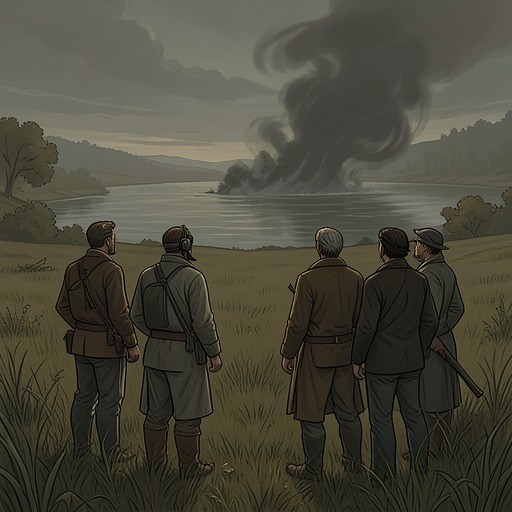
The Colour Out of SpaceThe November 3, 1927 flood in Vermont is the catalyst for Albert N. Wilmarth’s investigation of reports that strange beings had appeared in the floodwaters. The disaster itself remains distinct from the stories told about it: the accounts are uncertain, filtered through local folklore, and never established as proof. Their importance lies in how they unsettle Wilmarth’s confidence that such tales can be explained away, and open a path from regional legend to questions about the planet’s deep past.
Background and First Reports
Wilmarth, an instructor of literature at Miskatonic University in Arkham and an enthusiastic student of New England folklore, first encountered the reports shortly after the flood. News of hardship and organized relief dominated the press, but newspaper clippings also described unusual things seen in swollen rivers. Friends asked him to interpret the stories. Flattered by their interest in his research, he initially dismissed the reports as products of rustic superstition.
The reports appeared to resolve into three separate instances: one associated with the Winooski River near Montpelier, one with the West River in Windham County beyond Newfane, and one with the Passumpsic River in Caledonia County above Lyndonville. The accounts described unfamiliar, roughly human-sized forms, but witnesses reportedly rejected both human and known-animal explanations. Their descriptions converged on pinkish, crustacean-like bodies with large dorsal fins or membranous wings, articulated limbs, and an antenna-covered, rounded structure where a head might be expected. The striking similarity between accounts could suggest a shared source; Wilmarth, however, considered the influence of inherited stories a more likely explanation.
The Folklore Behind the Sightings
Wilmarth knew of older Vermont legends through a rare monograph by Eli Davenport, based on material gathered orally before 1839, and through stories he had heard from elderly people in the mountains of New Hampshire. These traditions placed a hidden race in remote forests, high peaks, and deep ravines. Signs attributed to the beings included unusual prints beside streams, circles of stones, caves obstructed by boulders, and rare sightings in isolated valleys.
Descriptions of the beings also recurred across the tales. They were imagined as large, light-red, many-legged creatures with bat-like wings, sometimes carrying objects with their front limbs or travelling in groups. Other stories placed them in the sky, or blamed them for the disappearance of people who ventured into secluded places. Later layers of legend described claw marks near farmhouse windows, offers made in buzzing imitations of human speech, and recluses suspected of secret dealings with the beings. These were not simply stories of monsters encountered in the wilderness: they also recorded inherited anxieties about settlement, isolation, and the boundaries people were advised not to cross.
Traditions differed over what the beings were. Some settlers interpreted them through Christian demonology; others connected them with fairy lore. Pennacook accounts, as Wilmarth presents them, described the Winged Ones as visitors from the northern stars who mined earthly hills, avoided people unless observed or approached, and communicated through changes in the colour of their heads. In the legends, warnings against listening to their imitations of human voices accompanied practical memories of dangerous or avoided places.
Custom, Skepticism, and the Limits of Explanation
According to Wilmarth’s account, these traditions faded during the nineteenth century. Settlement patterns and economic habits persisted after the reasons for them had been forgotten: certain hills remained reputedly unhealthy, unlucky, or unprofitable, while the remote areas associated with the stories were left largely alone. By the time of the flood, only occasional local scares and the memories of older people kept the legends in circulation. The old practice of avoiding particular places had become custom without a clear explanation.
Wilmarth initially used this folklore to explain the flood reports rather than to credit them. He argued that witnesses might have mistaken damaged bodies in the turbulent water for strange creatures, with half-remembered legends supplying the details. He also compared Vermont’s stories with familiar traditions of hidden beings elsewhere, including accounts of the Mi-Go in the Himalayas. To him, such cross-cultural similarities showed how recurring imaginative patterns could generate similar myths. His opponents drew the opposite conclusion: the persistence and consistency of the traditions, combined with the little-explored Vermont hills, made a surviving ancient race difficult to rule out. The flood reports thus exposed a dispute not only about what witnesses had seen, but about whether myth’s recurrence discredited it or pointed toward a shared historical source.
Aftermath and Narrative Significance
The flood did not settle that dispute. It gave Wilmarth a reason to examine the stories more closely, and the inquiry gradually joined folklore to reports, records, and claims about ancient remains. In later sections of his account, the scale widens beyond regional history: legends and impressions concern dominant species that preceded humanity, while the Great Race is described as having gathered knowledge across vast spans of time. Much later, reports of extremely ancient carved stones in Australia and the discovery of a book in ruins give those claims material weight within the narrative. They do not establish that the river witnesses saw the beings described in the Vermont legends, or explain what moved through the floodwaters.
That unresolved gap is central to the event’s role in the story. The flood first seems to offer a straightforward occasion for superstition: extraordinary water, distressed communities, and ambiguous objects interpreted through inherited tales. But the investigation makes confident dismissal harder, even as it never supplies conclusive verification of the original sightings. The date marks the point at which Wilmarth’s professional confidence in folklore as an explanation begins to give way to a more disturbing possibility—that human history and memory may be only a narrow interval within a much older world.